Chapter 8: Agents, Skills, and the Markdown OS
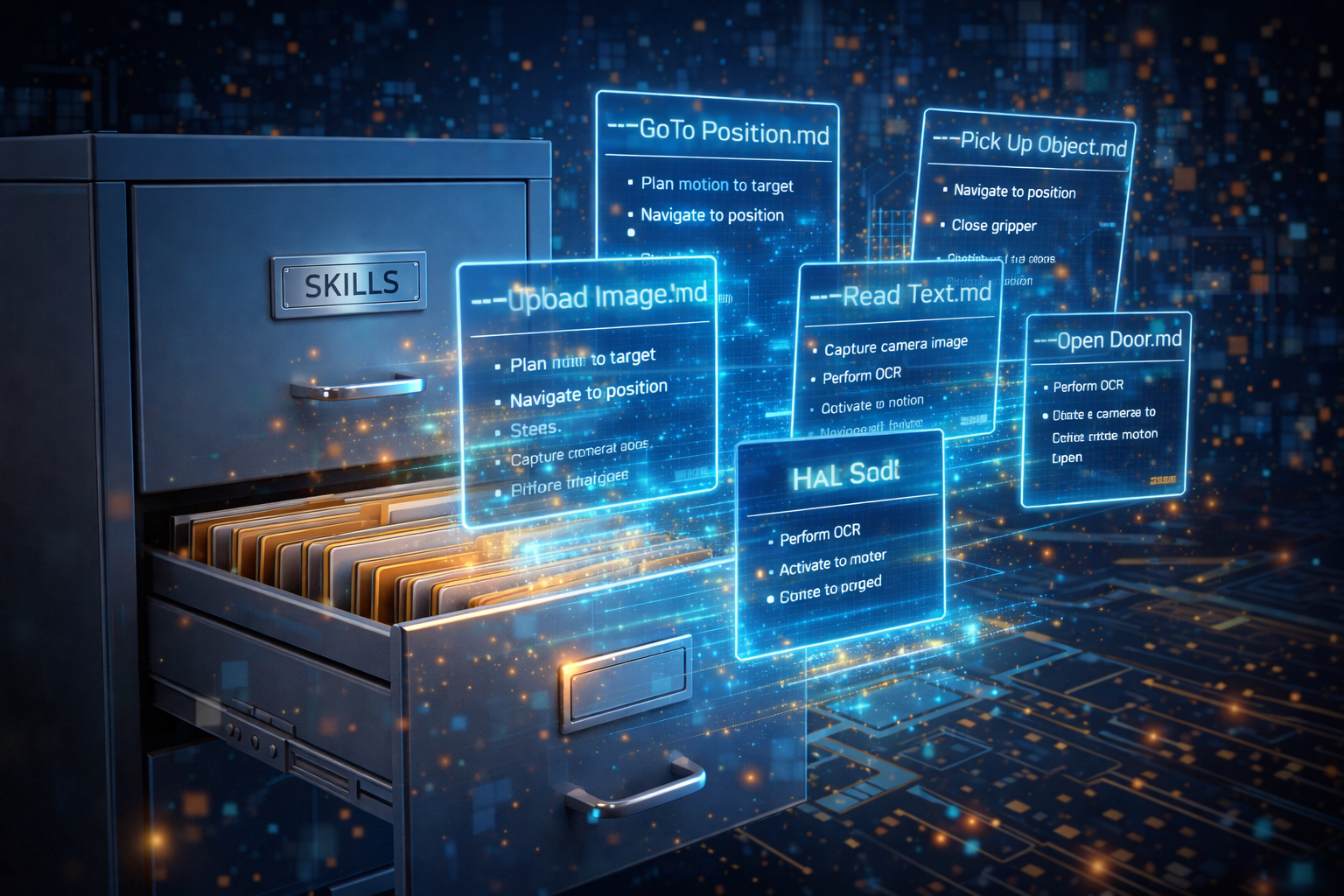
Most operating systems are written in C. Their kernels are compiled binaries. Their configuration lives in opaque registries or arcane dot-files. LLMos is different. Its kernel is markdown. Its agents are markdown. Its skills, memory, configuration, and orchestration rules are all structured text files with YAML frontmatter and prose bodies. This is not a limitation. It is the central architectural decision that makes the system self-modifying: an LLM can read, understand, and rewrite every component of the operating system using the same tools it uses to write any other text.
Everything is Markdown
In a traditional system, behavior lives in compiled code. Changing behavior requires modifying source, running a build, deploying, and restarting. In LLMos, behavior lives in markdown files. Changing behavior means writing a new paragraph. The change takes effect immediately. There is no build step.
This works because the LLM does not compile markdown into instructions. It reads markdown and follows it the way a human follows a recipe. The agent definition IS the documentation IS the execution specification.
The system is organized around three artifact types:
- Agents: Markdown files that define a persona, capabilities, tools, and prompt.
- Skills: Markdown files encoding reusable domain knowledge.
- Kernel rules: Markdown files defining system-level behavior.
Agent Definitions
An agent is a markdown file with YAML frontmatter followed by a system prompt. Here is
the Hardware Control Agent at public/volumes/system/agents/HardwareControlAgent.md:
---
name: Hardware Control Agent
type: agent
category: hardware
capabilities:
  - ESP32-S3 device control
  - Real-time sensor monitoring
  - GPIO state management
  - I2C/SPI communication
libraries:
  - Web Serial API
  - JSON protocol
version: 1.0.0
---

# Hardware Control Agent

Expert agent for controlling ESP32-S3 microcontrollers via Web Serial API.

## Role
Bridge between user intentions and hardware I/O. Translates natural
language requests into device commands and interprets sensor data.
The frontmatter declares identity, searchable capabilities, libraries, and version. The body is the system prompt: when the SystemAgent invokes this agent, it reads this file and follows its instructions.
The system ships with 13 agents in public/system/agents/:
| Agent | Role |
|---|---|
| SystemAgent | Master orchestrator |
| PlanningAgent | Task decomposition |
| MutationAgent | Code modification and evolution |
| ReactiveRobotAgent | Real-time reactive robot control |
| RobotAIAgent | AI-driven robot behavior |
| StructuredRobotAgent | Structured output for robot commands |
| ExecutionStrategyAgent | Model-aware execution planning |
| MemoryAnalysisAgent | Past experience analysis |
| MemoryConsolidationAgent | Short-term to long-term compression |
| PatternMatcherAgent | Semantic pattern detection |
| ProjectAgentPlanner | Multi-agent project planning |
| LensSelectorAgent | Analysis perspective selection |
| UXDesigner | Interface and experience design |
The Volume System
LLMos organizes knowledge into a three-tier hierarchy that reflects maturity.
System Volume (read-only)
Path: public/volumes/system/. Ships with the repository. Contains base agents, core
skills, and project templates. The manifest at manifest.json declares every file.
Currently: 1 agent, 1 tool definition, 20 skills.
Team Volume (shared)
Path: volumes/team/. Collective intelligence. Skills promoted from User after 5+
uses with 80%+ success rate.
User Volume (personal)
Path: volumes/user/. Working directory for experiments, execution traces, and new
agents before they earn promotion.
The Promotion Pipeline
Skills flow upward as they prove reliable. The implementation lives in
lib/skills/skill-promotion.ts:
// lib/skills/skill-promotion.ts
export const DEFAULT_PROMOTION_THRESHOLDS: PromotionThresholds = {
  user_to_team: {
    min_uses: 5,
    min_success_rate: 0.8,
  },
  team_to_system: {
    min_uses: 10,
    min_success_rate: 0.9,
  },
};
The SkillPromotionManager tracks every invocation and evaluates eligibility:
// lib/skills/skill-promotion.ts
export class SkillPromotionManager {
  recordUsage(skillId: string, skillName: string,
              volume: VolumeLevel, success: boolean): void { ... }

  evaluatePromotion(skillId: string): PromotionEvaluation | null {
    const metrics = this.metrics.get(skillId);
    const threshold = currentVolume === 'user'
      ? this.thresholds.user_to_team
      : this.thresholds.team_to_system;
    const eligible =
      metrics.total_uses >= threshold.min_uses &&
      metrics.success_rate >= threshold.min_success_rate;
    ...
  }
}
A personal experiment that succeeds 5 times at 80%+ becomes a team standard. A team standard that succeeds 10 times at 90%+ becomes a system primitive. This is Darwinian knowledge management.
Skills
Skills are reusable knowledge documents – not code, but structured explanations the
LLM reads and follows. From public/volumes/system/skills/esp32-cube-robot.md:
---
name: ESP32 Cube Robot Controller
category: hardware
description: Controls a two-wheeled differential drive cube robot
keywords: [esp32, robot, differential-drive, motor, cube, simulation, kinematics]
version: 1.0.0
---
The body includes hardware specs, protocol definitions, kinematics equations, movement pattern tables, code examples, and safety guidelines. The system volume ships with skills for ESP32 robotics, WASM development, flight controllers, plan-first execution, Python coding, semantic pattern matching, data analysis, and quantum circuit simulation.
Skills differ from agents: agents have a persona and act autonomously; skills are passive knowledge that agents consume. One agent might read three skills for a task.
The Kernel
The kernel is a set of markdown files in public/system/kernel/ that define
system-level behavior:
| File | Purpose |
|---|---|
config.md |
Runtime parameters, iteration limits, evolution thresholds |
orchestration-rules.md |
PLAN-EXECUTE-REFLECT-ITERATE loop |
evolution-rules.md |
Skill generation and agent evolution |
memory-schema.md |
Short-term traces, long-term learnings |
tool-registry.md |
Available tools and interfaces |
trace-linking.md |
Execution flow tracking metadata |
From config.md, the orchestration and evolution parameters:
orchestration:
  maxIterations: 15
  maxToolCalls: 50
  planFirst: true
  queryMemory: true

evolution:
  promotion:
    userToTeam:
      minUses: 5
      minSuccessRate: 0.8
    teamToSystem:
      minUses: 10
      minSuccessRate: 0.9
The orchestration rules define the core agentic loop: PLAN (analyze task, query memory, create steps), EXECUTE (run steps, make tool calls), REFLECT (evaluate, extract lessons), ITERATE (adjust and retry if incomplete). Confidence thresholds gate execution: above 0.8, execute freely; between 0.5 and 0.8, add checkpoints; below 0.5, ask the user.
The /llmos Command
The entry point is the /llmos slash command in .claude/commands/llmos.md. It
triggers an 8-phase workflow:
Phase 0: Agent Discovery. Glob all **/agents/*.md files across volumes. Build a
capability index from frontmatter.
Phase 1: Memory Consultation. Read system/memory_log.md and search project
memory for similar past tasks.
Phase 2: Planning. Create a multi-phase execution plan with sub-agent assignments.
Phase 2.5: Multi-Agent Planning. Every project must have at least 3 agents. Select by priority: copy (80%+ match), evolve (50-79%), or create from scratch.
Phase 3: Structure Creation. Create the project directory:
projects/[name]/
  agents/           # minimum 3 sub-agent .md files
  memory/
    short_term/     # execution traces
    long_term/      # consolidated learnings
  output/
    code/           # generated scripts
    visualizations/ # plots and images
  skills/           # reusable patterns
Phase 4: Agent Execution. Read each agent, generate code per its spec, invoke with
the invoke-subagent tool which tracks usage for evolution.
Phase 5: Synthesis. Combine results into documentation and summaries.
Phase 6: Validation. Verify the 3-agent minimum. If short, create more before proceeding.
Phase 7: Memory Update. Append experience entry to the system memory log with project name, outcome, agents used, and learnings.
Self-Modification
The most distinctive property of LLMos is that the system modifies itself. Because agents and skills are markdown files, the LLM can:
- Create new agents by writing a
.mdfile to an agents directory - Evolve existing agents by reading, modifying, and rewriting their definitions
- Generate skills when it discovers recurring patterns
- Update configuration to adjust thresholds and parameters
From the /llmos command specification:
“Agents = Markdown files with YAML frontmatter + system prompts. Memory = Structured markdown in memory/ directories. Skills = Reusable patterns in skills/ directories. Evolution = Writing/modifying markdown (no code deployment needed).”
When the system learns something, it writes a skill file. When it needs a capability, it writes an agent file. When it improves an agent, it edits the file and the improved version is available immediately. The TypeScript runtime provides deterministic execution. The markdown provides adaptive behavior.
Model-Aware Execution
The kernel maps models to execution strategies in config.md:
models:
  anthropic/claude-opus-4.5:
    strategy: "markdown"
    supportsNativeAgents: true
  openai/gpt-4o:
    strategy: "compiled"
    supportsNativeAgents: false
  google/gemini-2.0-flash:
    strategy: "compiled"
    supportsNativeAgents: false
Claude models consume raw markdown agents directly. Other models get agents compiled into structured formats with explicit tool definitions. Smaller models get minimal, numbered instructions. The agent file is the single source of truth; the execution strategy adapts at runtime.
At runtime on physical robots, Qwen3-VL-8B takes over from Claude. It consumes the same skill specifications through the “simple” strategy: a camera frame, an ASCII world model, and candidate actions in, a structured JSON decision out.
Chapter Summary
LLMos is an operating system where everything that defines behavior is a text file.
Agents are markdown with YAML frontmatter. Skills are structured knowledge documents.
Kernel rules are configuration in prose. The three-tier volume system creates a
pipeline where good patterns propagate upward through meritocratic promotion. The
/llmos command triggers an 8-phase workflow from discovery through memory update.
The deepest implication is self-modification. The system improves through use. Every task becomes a data point. Every successful pattern becomes a promotion candidate. The robot learns not by retraining a neural network, but by writing better documentation for itself.
Previous: Chapter 7 – The HAL: One Interface, Two Worlds Next: Chapter 9 – Predictive Intelligence: Thinking Before Acting