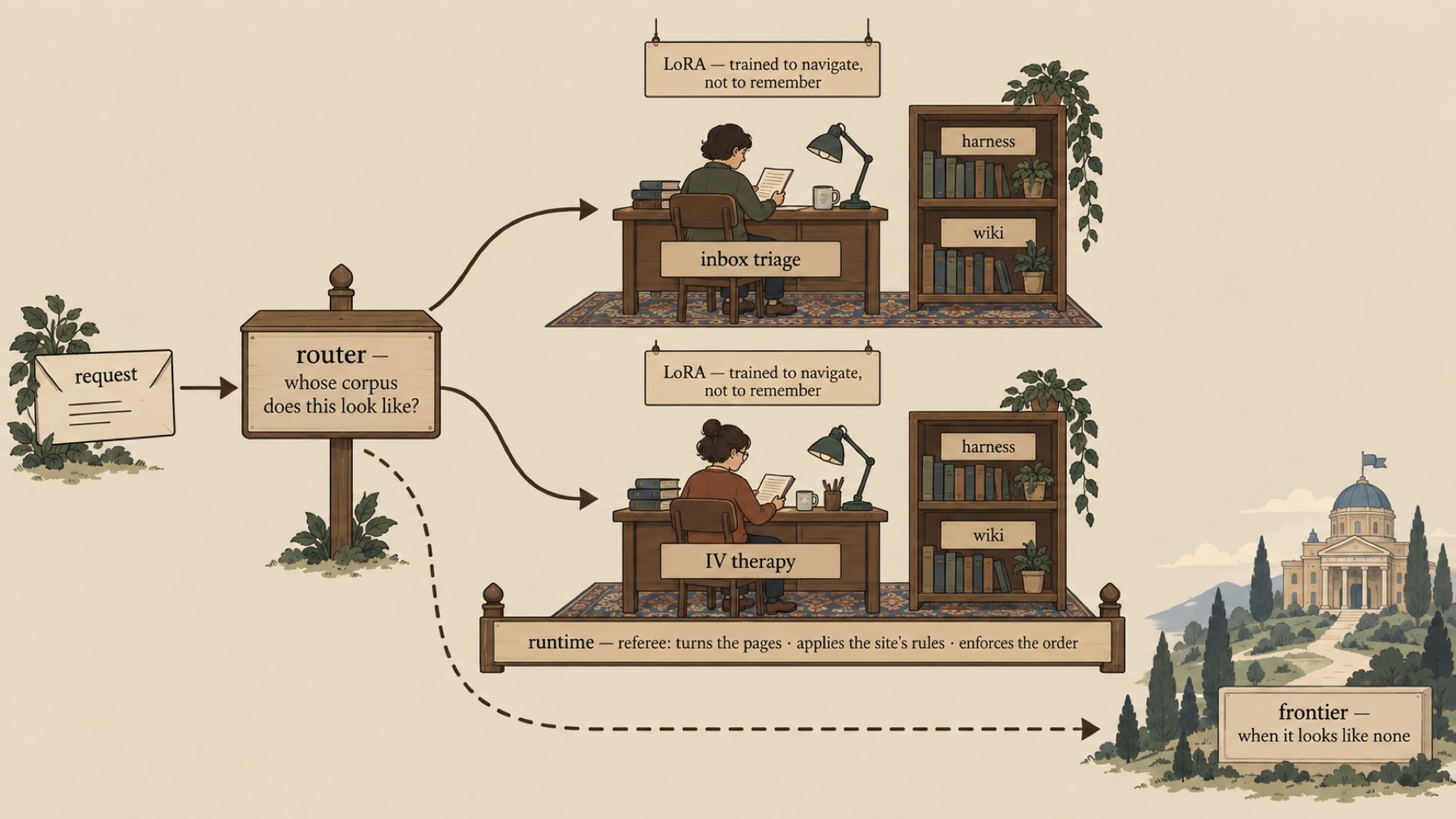
The LoRA is not the textbook. It is the specialist who knows how to use the library.
One GPU, one small resident model, and a shelf of QLoRA adapters — each an
expert defined by its corpus. An OpenAI-compatible API reads every request,
serves it with the expert whose corpus it falls in, and sends everything else to a
frontier model. The client names no model.
Version 1.0 adds what a small expert cannot hold in its weights: a library of short
notes per subdomain, and an adapter trained on the habit of navigating it.
The weights hold the navigation; the notes hold the content, and a person can read,
diff and correct them.
The specialist, the library, the radar that lights the drawers worth opening —
and, through the door, the frontier for everything else.
The finding that reorganised the project
11 of 90 became 90 of 90
Same adapter, same cases. Only the serving path changed.
A fluid-mechanics expert — 6-to-9-step chains with a calculator and a
per-case handbook — scored 11/90 when tool results came back as
tool_calls messages. Written inline, the way its corpus taught it to read them,
it scores 90/90 (79 : 0, paired). For four days that gap had been read as
“small models cannot reason”.
An expert is its corpus
Tool block, argument order, system prompt, result format.
Under a foreign system prompt 2 of 32 live turns call a tool; under its own,
19 of 32. Serve an expert the way its corpus taught it, and suspect the path before
the model.
The pool moves bases and holds
Same corpora, same recipe, a new base.
Both released members were retrained on Qwen3.5-4B and each
ties its own earlier release: inbox triage 471/475, desk commitments
240/240. They have since moved again: every released member is now on Gemma 4 E4B,
and the Qwen releases stay as the control arm.
What stays text
What deliberately never becomes a weight?
The library. A weight delta cannot be read, cited or corrected by a person;
a half-page note can. Site rules override the textbook before the expert ever sees
the note.
The core of version 1.0
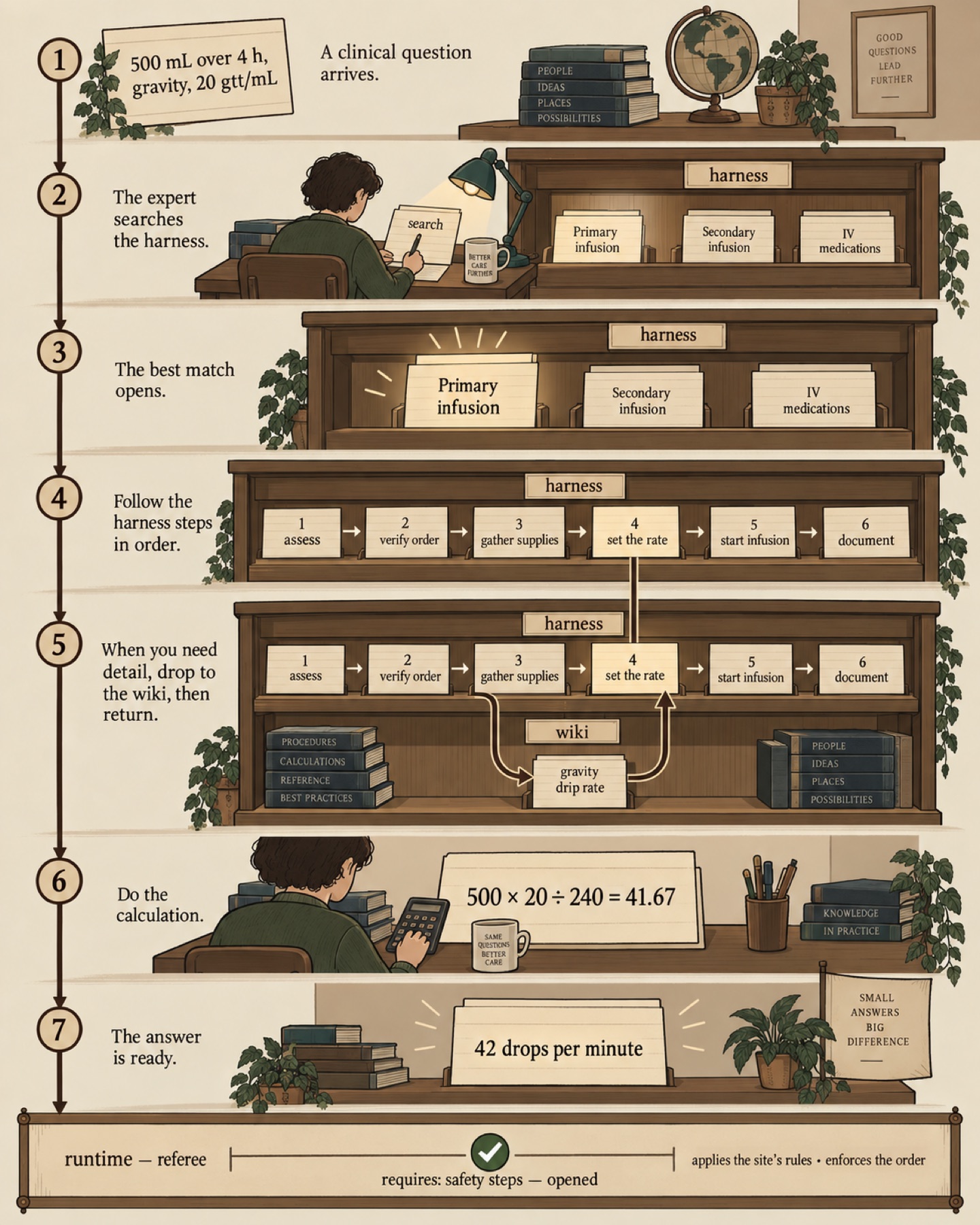
Five things: experts, a router, the memory, a runtime that referees, and a release
contract that nothing ships without.Three verbs — search, open, calc —
with results written inline. A software referee turns the pages, applies the site's rules
and cuts a walk that skips a required step.
built — measured in part All five parts
are built. Libraries now exist over an open textbook’s procedures (CC BY 4.0) and over
US regulations ingested verbatim. On real documents the central claim holds where it was measured:
an expert trained on walks over one regulation family cites on a family it never saw, and a number
edited in the library after training is answered from the edit (below). On generated procedures it
did not: the library arm did not beat the untrained base handed the same notes.
What is measured
what
the number
run
A reasoning expert served the way its corpus taught
90/90 against 11/90 through tool_calls, 79 : 0 paired
M7 arm 0b
Inbox triage, retrained on Qwen3.5-4B
471/475, a tie with its earlier release; the bare base scores 346/475
M1
A second expert on the same inbox, a different question
240/240, a tie with its earlier release
M1
The API routes per request; the client names no model
0.546 → 0.775 on a 240-case replay, 0 misrouted
P41, P62
A procedure merely pasted into a 3B’s prompt is not followed
0 tool calls on 351/351; the trained expert beats it 137 : 1
P61
Trained on walks over real regulations, an expert cites on a regulation family it never saw
18/23 against the untrained base’s 9/23, 10 : 1 paired; a second seed ties it
REAL3
A number edited in the library after training is answered from the edit, not the weights
17/17 rows answer the new value, each cited to the edited statement, 0 stale
EDIT0
The router that replaced the keyword dictionary as the default: a request is factored into its task and its content
foreign text served locally 0/600 against the dictionary’s 294/600; unseen senders 0 of 120 lost
ROUTE0
A long-policy, multi-turn agent benchmark (τ²-bench airline, 20 test tasks × 4 trials), untrained bases — a headroom check, no member trained yet
Gemma 4 12B pass^1 0.45 against the E4B’s 0.175, +27.5 pp, 10 : 0 tasks; the 31B’s 0.5375 is +8.8 pp over the 12B, inside the noise
T1, T1b
What is not, or does not work
No real traffic yet. Suites are generated, or built from real documents ingested verbatim;
live runs go through a real agent runtime, on synthetic organisations.
The router is literal by design. A paraphrase of a member’s task is sent to the frontier,
not served locally (0/120 kept local), and two learned routers — n-grams and embeddings —
both lost every request from a sender they never saw.
The radar that picks which notes to open has not passed its gate, and the library arm lost
its kill test on generated procedures.
Not installable yet. There is no package or container, and the serving code does not yet load
the per-role packs it lints. What exists is a research codebase whose runs are reproducible on Colab.
The saving in money is not established. The frontier side of a replay has been costed; the
local GPU has not, and none of it is real traffic.
The full ledger, including everything that failed and the instruments that lied:
RECORD.md. The position:
PLAN.md.
Where it sits in an organisation
One expert per role
Under the agent column, not beside it.
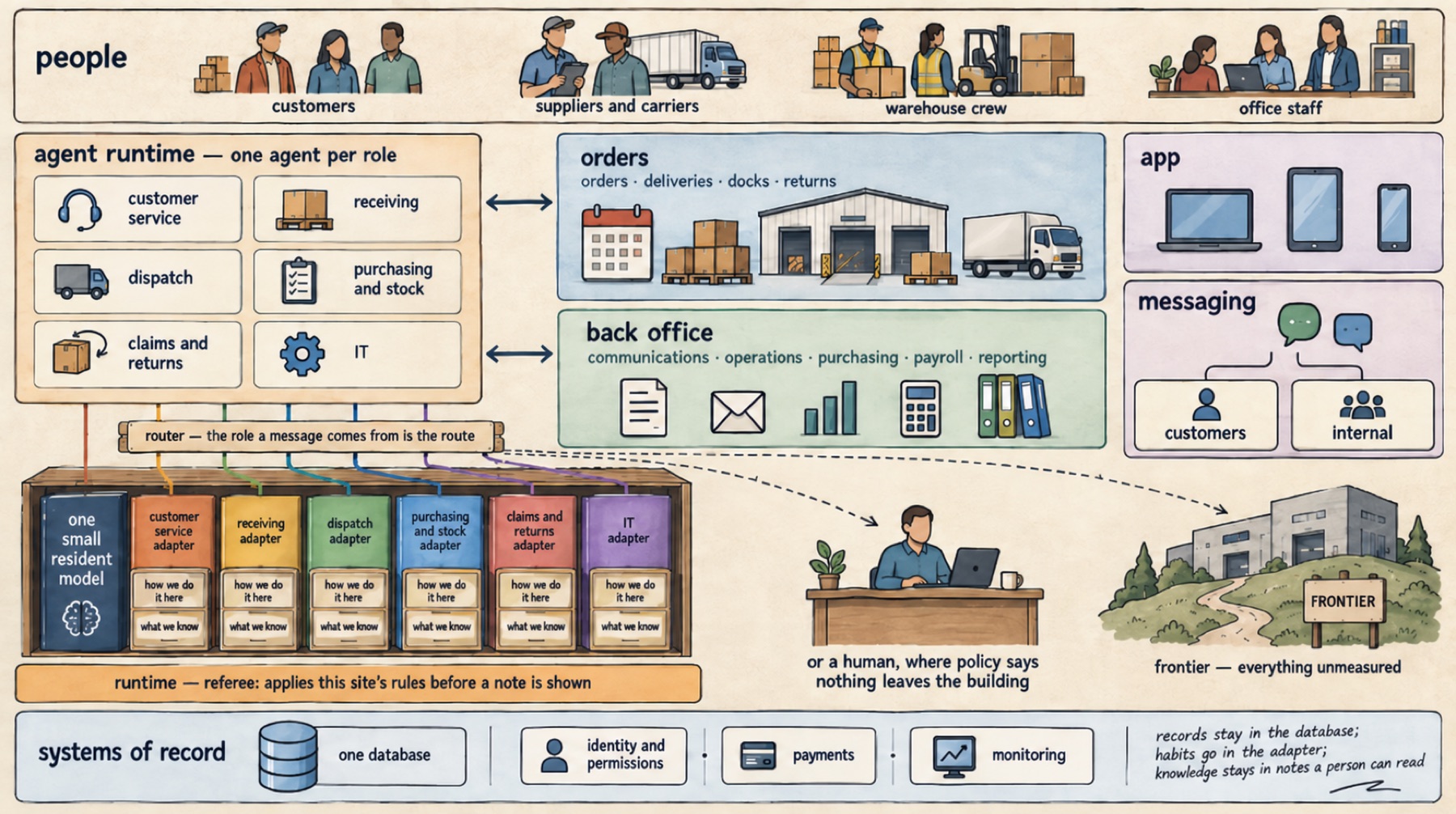
An organisation that runs on agents draws the same picture: people in a few
roles, an agent runtime with one agent per role, the applications they operate, the channels
people already use, and one database underneath. In that picture every agent is a system
prompt over the same remote model. Here each role becomes an expert — an adapter
trained on how this organisation does that job — and the role a message arrives
from is the route.
Three places for three things
Records, habits, knowledge.
Records stay in the database. Habits go in the adapter. Knowledge stays in
notes a person can read and correct — two drawers per role: how we do it here, and
what we know. What an expert is measured to handle is answered on the organisation’s own
machine; the rest goes to the frontier, or to a person where policy says nothing leaves the
building.
A distributor, as the example: one adapter per role under the agent column, two drawers of
notes under each, the role as the route — and the systems of record left where they are.
the escalation procedure per building · contracts, by-laws, supplier terms
not measured These are where the design points,
not results. What they share is what makes a region worth an expert: the same few procedures,
repeated daily, with local rules that differ from the textbook, over data that should not leave.
The first library in the repository is built from an open textbook’s step-by-step procedures.
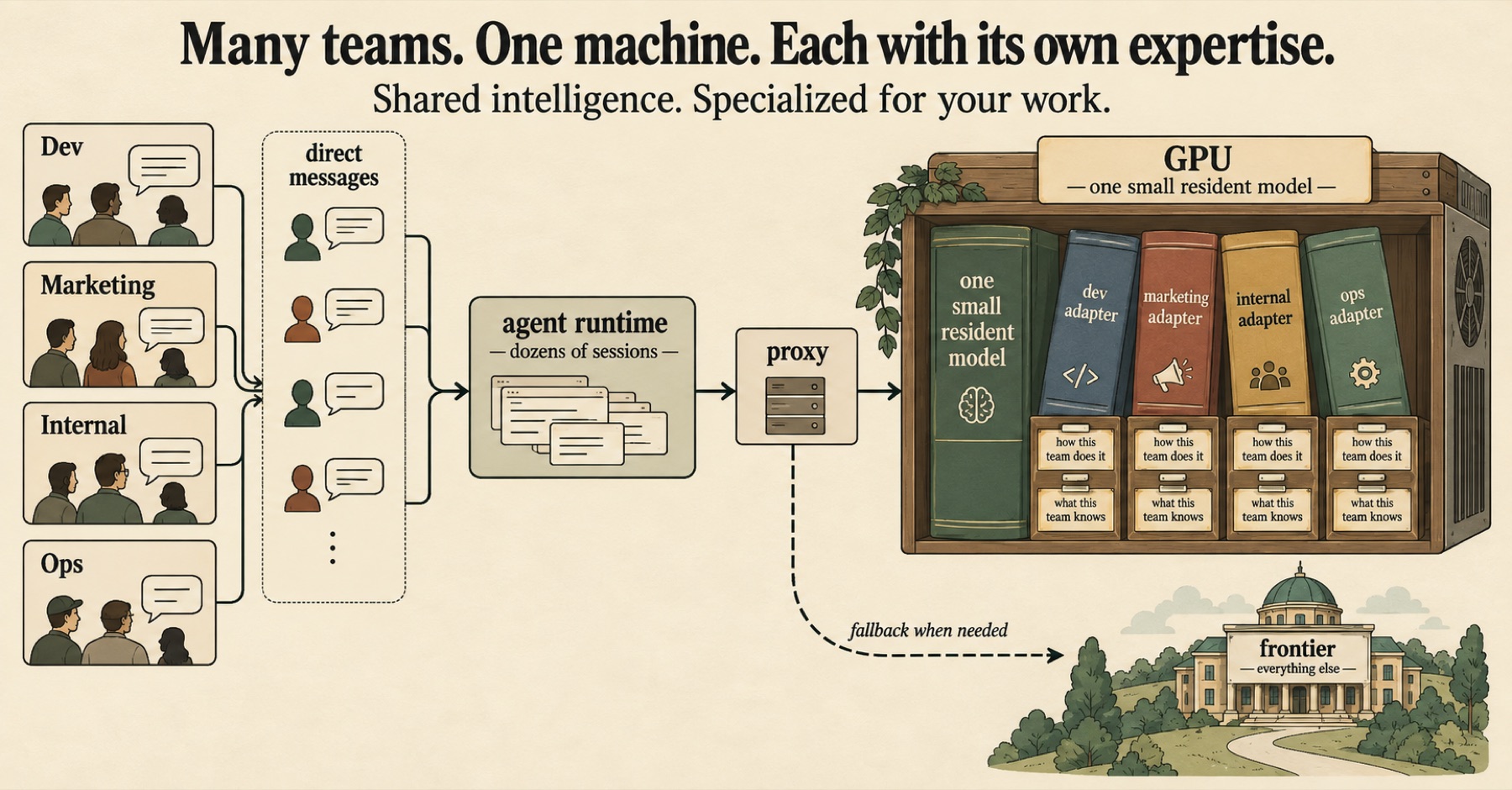
For a team running agents together
Many teams, one machine. The group a message arrives from is the route: each
team gets an adapter and two drawers — how this team does it, what this team knows.